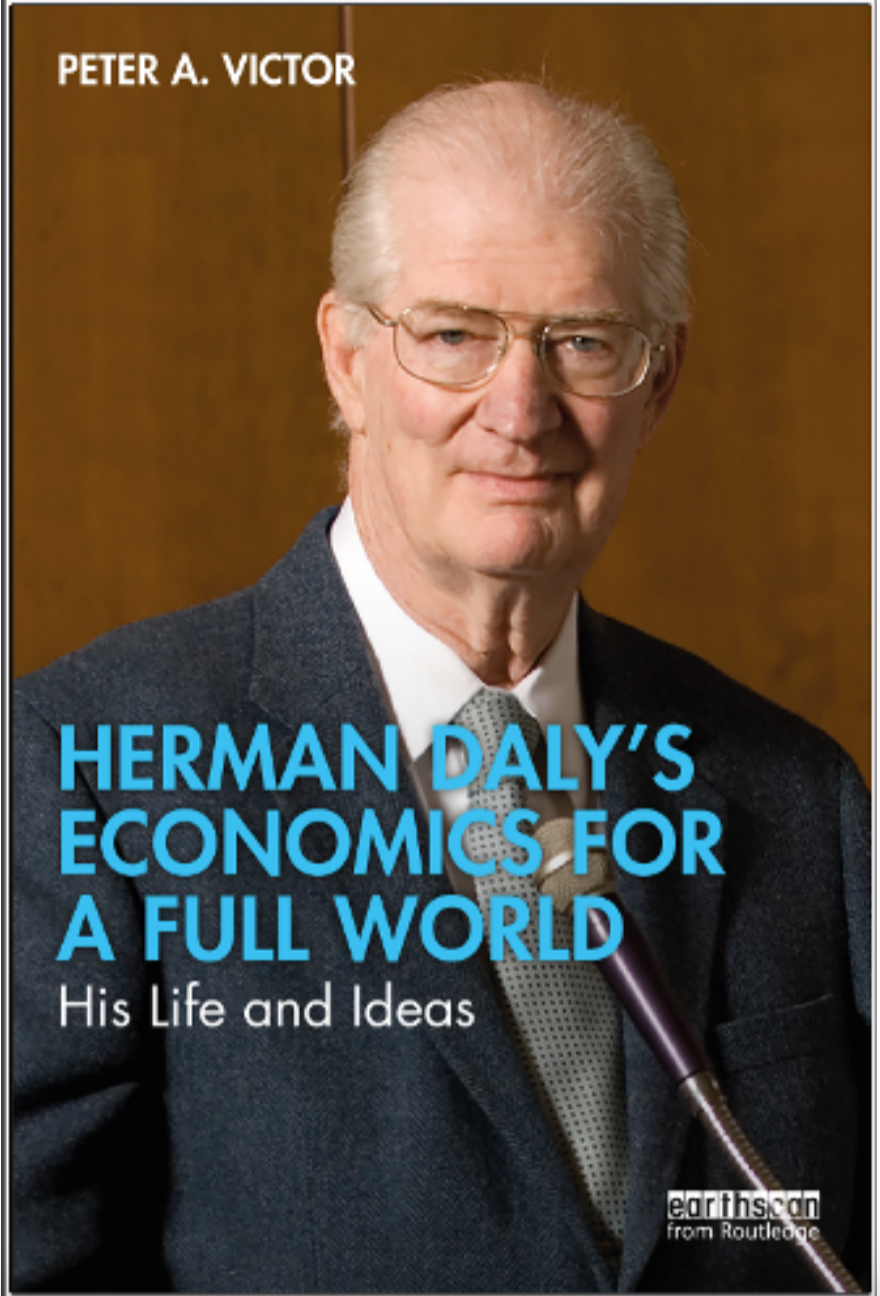
Herman Daly's Economics for a Full World. His Life and Ideas (2022)
By, Peter A. Victor
Herman Daly’s Economics for a Full World: His Life and Ideas is both an intellectual biography and a synthesis of Daly’s major contributions to ecological economics. Victor’s biography situates Daly’s ideas in his life story, showing both the influence Daly had on ecological economics and the debates his analysis and proposals provoked. Daly’s work remains a foundational challenge to growthcentric policy, offering a practical, morally grounded blueprint for navigating a world that is, increasingly, full.
Born in 1938 in Houston, Daly's early experiences—illness, exposure to poverty, upbringing, and academic training—shaped a moral and ecological critique of mainstream economics. Over decades at institutions including Louisiana State University, the World Bank and the University of Maryland, he argued that mainstream growth models ignore physical laws (notably thermodynamics) and the planet’s regenerative and absorptive capacities.
Daly argued that the human economy has outgrown the biophysical limits of the Earth, and only a steadystate economy—focused on qualitative development rather than quantitative expansion—can sustain wellbeing in a 'full world.' He distinguished an 'empty world'—where growth raises welfare because nature’s capacity is abundant—from a 'full world', where growth becomes uneconomic as environmental and social costs outweigh benefits. He was skeptical that technological decoupling alone can reconcile perpetual growth with planetary limits urging that institutional and cultural must change to prioritize sustainability and justice.
Daly’s proposals combine technical constraints with ethical commitments: cap and trade or ecological taxes to limit resource use, rights to common resources, and alternative wellbeing metrics beyond GDP. His steadystate economics prescribes limits on throughput, stable population, and a shift from quantitative growth to qualitative development, while insisting policy must address 'scale' (how big the economy is), 'distribution' (how wealth is shared), and 'allocation' (how markets assign resources).
With increasing degradation of ecosystems around the world, Daly's insights, analysis, and proposals for a steady-state economy are more relevant than ever.